

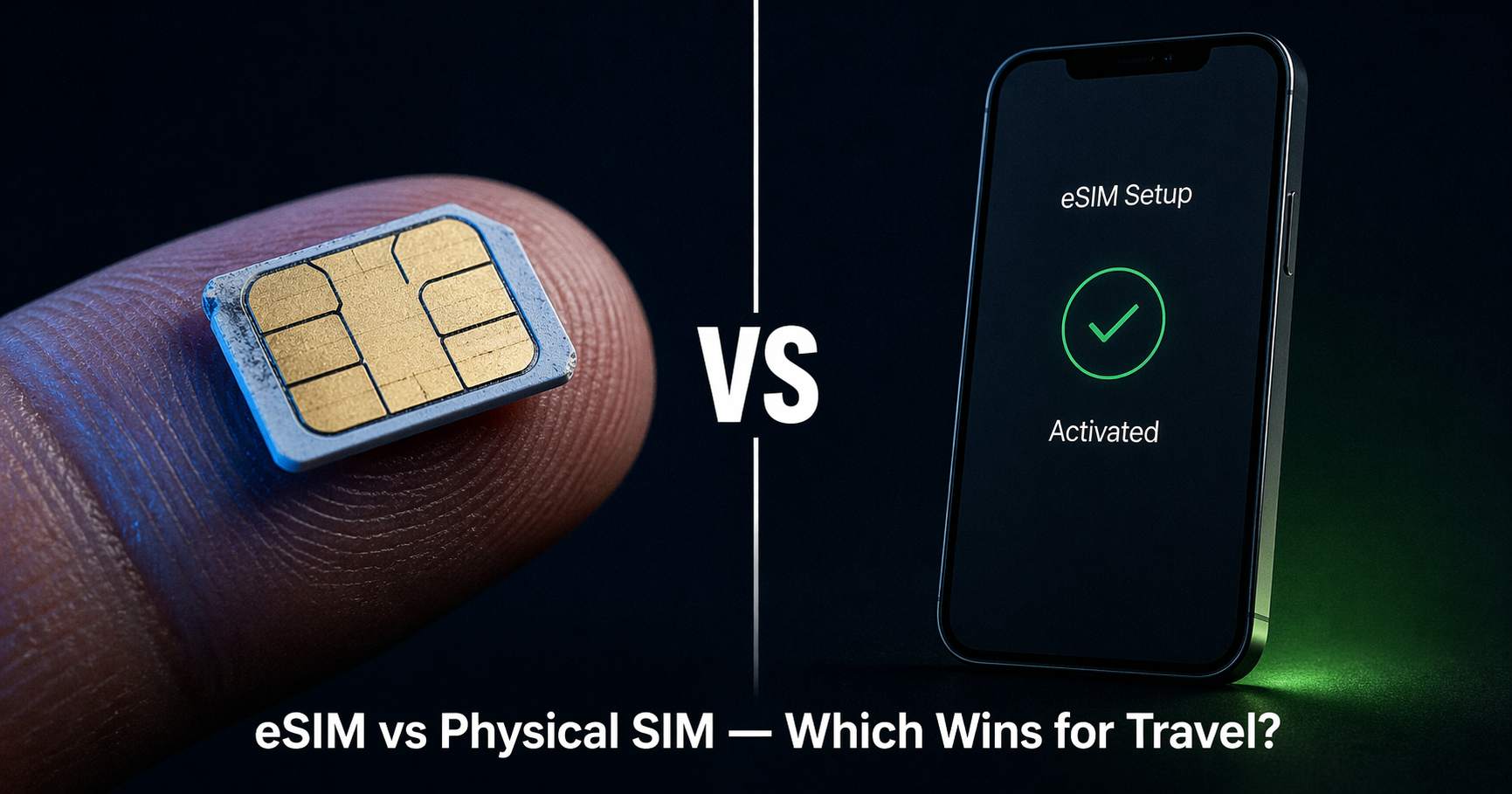
eSIM vs Physical SIM Card: Which Is Better for Travel in 2026?
Compare eSIM and physical SIM cards for international travel, including setup, speed, privacy, cost, iPhone support, compatibility, and which option makes more sense for your next trip.
Quick Answer: eSIM Is Usually Better for Most Travelers
For most short-term international travelers in 2026, eSIM is usually more convenient than a physical SIM card. You can buy a plan before departure, install it digitally, keep your original SIM in your phone, and connect after arrival without searching for a local SIM card store.
However, a physical SIM card may still be better if your phone does not support eSIM, your device is carrier-locked, you need a local phone number, or you are staying in one country for a long time.
eSIM vs Physical SIM Card: Quick Comparison
If you only want a fast overview, this table shows the main differences between an eSIM and a physical SIM card for travel.
| Feature | eSIM | Physical SIM Card |
|---|---|---|
| Setup | Activated digitally by QR code or manual details | Requires inserting a physical SIM card |
| Best for travel | Short trips, business trips, and multi-country travel | Older phones, long stays, or users needing local numbers |
| Delivery | Usually sent digitally after purchase | Requires store pickup, shipping, airport kiosk, or local purchase |
| Device requirement | Requires an eSIM-compatible and unlocked device | Requires an unlocked phone with a SIM card slot |
| Speed | Depends on local network, signal, carrier, and plan conditions | Depends on local network, signal, carrier, and plan conditions |
| Security | No removable card, so it cannot be physically lost like a SIM card | Can be removed, lost, damaged, or misplaced |
| Calls and SMS | Many travel eSIM plans are data-only | Some local SIM plans may include calls and SMS |
| Convenience | High — no SIM swapping needed | Medium — requires handling and storing a physical card |
What Is an eSIM?
An eSIM is a digital SIM built into your phone, tablet, or connected device. Instead of inserting a plastic SIM card, you install a mobile plan by scanning a QR code or entering activation details manually.
For travel, an eSIM lets you purchase a mobile data plan online before your trip. Once installed, you can use the plan in the covered destination according to the provider’s activation instructions.
eSIM is commonly used by travelers who want mobile data for maps, ride-hailing apps, hotel check-in, messaging, translation, email, and other internet-based services.
FlowGo eSIM works with unlocked devices that support eSIM. Before purchasing, you can check our eSIM compatible devices list to confirm whether your phone is supported.
What Is a Physical SIM Card?
A physical SIM card is the traditional removable SIM card that you insert into your phone. It may also be called a normal SIM, regular SIM, traditional SIM, or plastic SIM card.
To use a physical SIM card while traveling, you usually need to buy one at an airport kiosk, mobile store, convenience store, or online. Then you insert it into your phone and follow the local activation process.
Physical SIM cards can still be useful for older phones, long-term stays, or travelers who need a local phone number with calls and SMS.
Pros and Cons of eSIM for Travel
Pros of Using eSIM
- You can buy it before departure. This helps you avoid looking for a SIM card store after landing.
- No physical SIM swap is needed. You can usually keep your original SIM in your phone.
- It is convenient for multi-country trips. Regional or global eSIM plans may cover several destinations under one plan.
- There is no small SIM card to lose. This is useful when traveling with important banking or verification services linked to your main number.
- It is easy to compare plans online. You can compare destination, data amount, validity, and price before your trip.
Cons of Using eSIM
- Not every device supports eSIM. Compatibility depends on device model, country, region, and sometimes carrier settings.
- Your phone should be unlocked. A carrier-locked phone may not work with a travel eSIM.
- Many travel eSIM plans are data-only. They may not include a local phone number, voice calls, or SMS.
- First-time setup may feel unfamiliar. Users should follow installation instructions carefully.
- Refund conditions may depend on activation status. Always read the plan details before purchase.
Important: FlowGo eSIM plans include mobile data only. They do not include a phone number, voice calls, or SMS. You can use mobile data with apps such as WhatsApp, FaceTime, Messenger, WeChat, Telegram, and other internet-based communication apps.
Pros and Cons of Physical SIM Cards
Pros of Using a Physical SIM Card
- Works with many older phones. If your phone does not support eSIM, a physical SIM may be your only option.
- May include local calls and SMS. Some local prepaid SIM cards include a local number.
- Can be suitable for long-term stays. A local physical SIM may make sense for students, workers, or long-term visitors.
- In-person support may be available. Some users prefer help from store staff during setup.
Cons of Using a Physical SIM Card
- You may need to buy it after arrival. This can be inconvenient if you need maps, taxis, or messages immediately.
- Airport SIM cards may be expensive. Tourist SIMs at airports are not always the cheapest option.
- You may need to remove your home SIM. This creates a risk of losing your original SIM card.
- Local registration may be required. Some countries require passport registration or identity verification.
- It may be less convenient for multi-country travel. You may need separate SIM cards or roaming options.
Is eSIM Faster Than a Physical SIM?
Not necessarily. An eSIM is not automatically faster or slower than a physical SIM card.
Mobile data speed mainly depends on local network coverage, carrier network quality, signal strength, network congestion, your device model, the plan’s speed policy, and whether the plan supports 4G, LTE, or 5G in that destination.
The main advantage of eSIM is not that it always has faster raw speed. The real advantage is that it can be faster to set up and easier to use after arrival.
In other words, both eSIM and physical SIM can provide good mobile data speeds. The difference is usually convenience, not the SIM format itself.
Is eSIM More Secure Than a Physical SIM?
In some ways, yes. An eSIM can be more secure against physical theft because it cannot be removed from your phone like a plastic SIM card.
A physical SIM card can be removed, lost, damaged, or misplaced when switching cards during travel. An eSIM avoids that specific risk because there is no removable card.
However, eSIM security still depends on how well you protect your phone, email account, eSIM QR code, Apple ID or Google account, and order information.
You should not share your eSIM QR code publicly or send it to anyone you do not trust. If your device is lost or stolen, contact your provider as soon as possible.
Which Is Better for iPhone Users?
For many iPhone users, eSIM is a very convenient option for travel. Most iPhone models from iPhone XS, iPhone XS Max, iPhone XR, and newer support eSIM.
Many newer iPhones also support Dual SIM, which may allow you to keep your main phone number active while using a travel eSIM for mobile data.
However, iPhone eSIM support can vary by region. Some iPhones purchased in mainland China may not support eSIM. In some markets, newer iPhone models may be eSIM-only and may not include a physical SIM tray.
How to check eSIM support on iPhone
- Go to Settings.
- Tap General.
- Tap About.
- Look for an EID number.
If your iPhone has an EID, it usually means the device supports eSIM. You should also confirm that the phone is unlocked and that your destination is covered by your travel eSIM plan.
Which Is Better for Android Users?
Android eSIM support depends heavily on the brand, model, country, region, and carrier. Many newer Samsung Galaxy, Google Pixel, Motorola, Sony, OPPO, OnePlus, Huawei, and Xiaomi devices may support eSIM in certain regions, but not every model does.
A global version of a phone may support eSIM, while another regional version of the same model may not. This is why checking your exact device variant is important.
How to check eSIM support on Android
- Go to Settings → Connections → SIM Manager and look for Add eSIM.
- Or go to Settings → Network & Internet → SIMs and look for Add SIM.
- You can also dial *#06# and check whether an EID appears.
Not sure whether your phone supports eSIM? Visit the FlowGo eSIM compatible devices page before buying a plan.
Which Is Better for International Travel?
The best choice depends on your device, destination, travel length, and whether you need mobile data only or also need calls and SMS.
Choose eSIM if:
- Your phone supports eSIM.
- Your phone is unlocked.
- You want mobile data ready before arrival.
- You are taking a short international trip.
- You are visiting multiple countries.
- You want to keep your original SIM in your phone.
- You mainly use apps for calls and messages.
Choose a physical SIM if:
- Your phone does not support eSIM.
- Your phone is carrier-locked.
- You need a local phone number.
- You need traditional calls or SMS.
- You are staying in one country for a long time.
- You prefer in-store setup support.
- A local long-term plan better fits your needs.
Before Buying a Travel eSIM, Check These 5 Things
Before purchasing a travel eSIM, it is important to check a few details. This can help you avoid setup problems, coverage issues, or buying the wrong plan.
1. Check whether your device supports eSIM
Your device must be eSIM-compatible. Check for an EID number in your device settings or use a reliable compatibility page.
2. Make sure your phone is unlocked
If your phone is locked to a specific carrier, it may not work with a travel eSIM. Contact your carrier if you are unsure.
3. Confirm your destination is covered
Make sure the eSIM plan covers the country or region you are visiting. For multi-country trips, consider a regional or global plan.
4. Check data amount and validity
Choose a plan that matches your trip length and usage. Maps and messaging use less data, while video, hotspot, and work apps may need more.
5. Read activation and refund conditions
Some eSIM plans start validity after installation, while others start after connecting to a supported network. Refund policies may depend on whether the eSIM has been installed, activated, or used.
Does eSIM Affect WhatsApp, iMessage, or Your Main Number?
In most cases, using a travel eSIM for mobile data does not require you to change your WhatsApp, iMessage, FaceTime, Messenger, WeChat, Telegram, or main phone number.
Many travelers use their eSIM for mobile data while keeping their original SIM active for their main number. This allows internet-based communication apps to continue working over mobile data.
To avoid unexpected roaming charges, check your phone settings before traveling. You may want to turn off data roaming for your primary SIM and use the travel eSIM as your mobile data line, depending on your device and eSIM instructions.
Final Verdict: eSIM or Physical SIM Card?
For most travelers in 2026, eSIM is usually the better choice for international travel because it is easier to buy before departure, faster to set up, and more convenient than swapping physical SIM cards.
eSIM is especially useful if you have an unlocked eSIM-compatible phone, want mobile data ready when you arrive, are taking a short trip, are visiting multiple countries, or want to keep your original SIM card in your phone.
However, physical SIM cards still make sense if your phone does not support eSIM, if you need a local phone number, or if you are staying in one country for a long time.
The best option is not the same for everyone. Before you choose, check your device compatibility, carrier lock status, destination coverage, data needs, and whether you need calls or SMS.
Ready to Travel with eSIM?
Before buying a travel eSIM, make sure your phone supports eSIM and is unlocked. Then choose a FlowGo eSIM plan for your destination and stay connected without changing your physical SIM card.
FlowGo eSIM plans provide mobile data only. They do not include a phone number, voice calls, or SMS.
FAQ: eSIM vs Physical SIM Card
Is eSIM better than a physical SIM for travel?
For most short-term international trips, eSIM is usually better because you can buy it before departure, install it digitally, and avoid searching for a local SIM card after arrival. However, a physical SIM may be better if your phone does not support eSIM or if you need a local phone number.
Is eSIM faster than physical SIM?
Not necessarily. eSIM is not automatically faster than a physical SIM. Speed depends mainly on the local network, coverage, carrier, signal strength, network congestion, and plan conditions. The main advantage of eSIM is faster setup and easier access to mobile data.
Can I use eSIM and physical SIM at the same time?
Many modern phones support Dual SIM, allowing you to use an eSIM and a physical SIM at the same time. For example, you may use your travel eSIM for mobile data and keep your physical SIM active for calls or SMS. Availability depends on your device model and region.
Is eSIM more secure than a physical SIM card?
An eSIM can be more secure against physical theft because it cannot be removed from your phone like a physical SIM card. However, you still need to protect your phone, email account, QR code, and mobile account information.
Does iPhone support eSIM?
Most iPhone XS, iPhone XS Max, iPhone XR, and newer models support eSIM. However, eSIM support may vary by region. Some iPhones purchased in mainland China may not support eSIM. Check for an EID number in Settings before buying a travel eSIM.
Do I need to remove my physical SIM to use eSIM?
In most cases, no. If your phone supports Dual SIM, you can keep your physical SIM in your phone and use an eSIM for travel data. This allows you to keep your main number while using a separate data plan abroad.
Is eSIM better than a normal SIM?
For travel, eSIM is often more convenient than a normal or physical SIM because it can be installed digitally and does not require a physical card. However, a normal SIM may still be better for older phones, long-term stays, or users who need local calls and SMS.
What should I check before buying a travel eSIM?
Before buying a travel eSIM, check that your device supports eSIM, your phone is unlocked, your destination is covered, the data amount fits your trip, and you understand whether the plan includes data only or also supports calls and SMS.
Is eSIM good for multi-country travel?
Yes, eSIM can be very convenient for multi-country travel, especially if you choose a regional or global plan that covers multiple destinations. This can help you avoid buying a new physical SIM card in each country.