

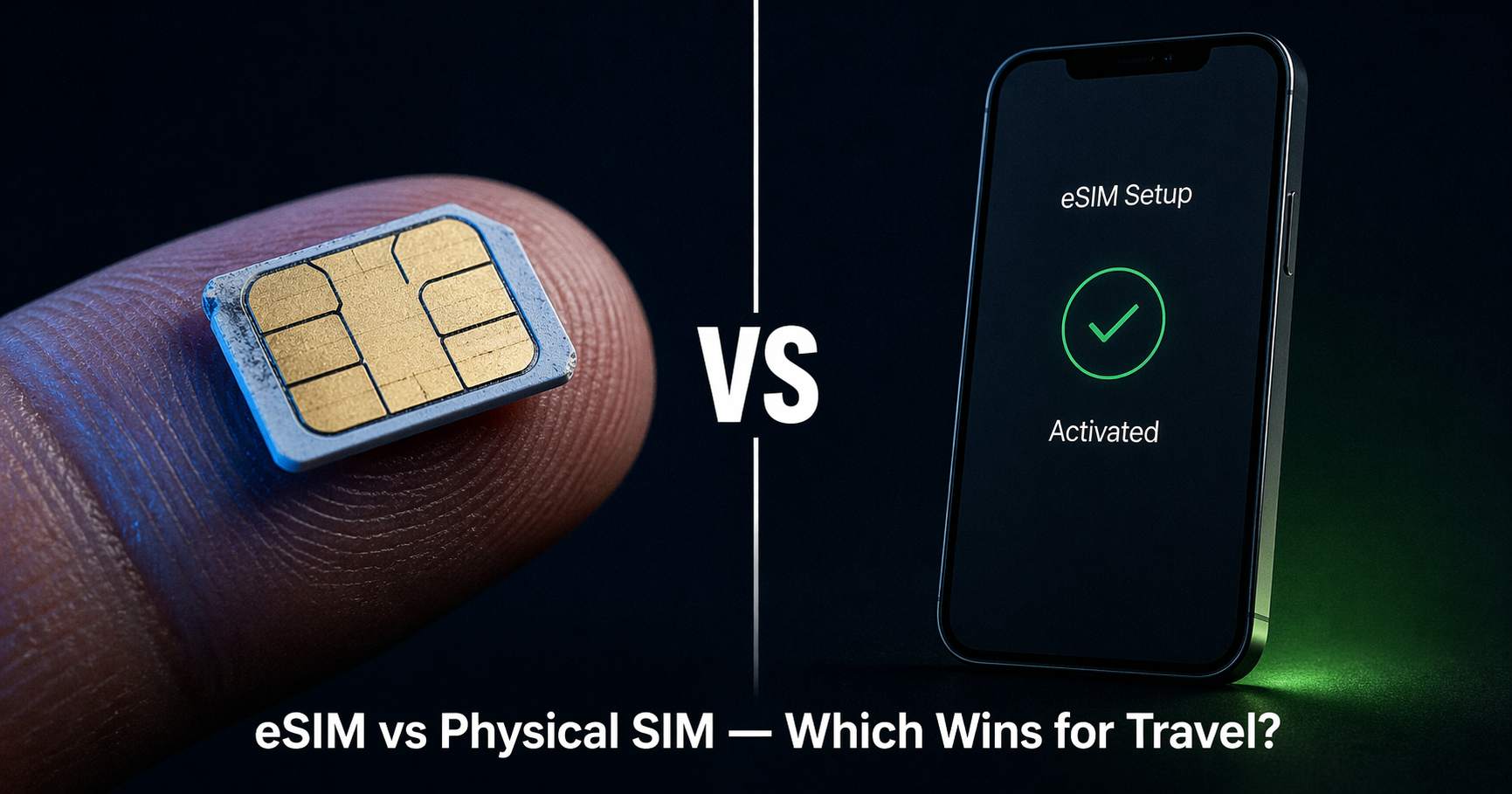
eSIM vs Physical SIM Card
Which Is Better for Travel?
The honest breakdown — covering speed, signal, security, and cost. No fluff, just what actually matters when you're on the road.
It's 1:30am. You've just landed in a country you've never been to. Your connecting flight was delayed, your checked bag is somewhere between two airports, and you have no idea where your hotel is. You need Google Maps. Now.
You reach into your pocket for that little plastic SIM card you bought before the trip — and it's gone. Probably fell out at the last airport. The SIM card shop in this terminal closed at midnight. The airport WiFi requires a local phone number to verify. You're standing there with a fully charged phone that's completely useless.
This exact situation has happened to more travelers than anyone wants to admit. It's also completely avoidable — and it's the single best argument for switching to eSIM.
What Is an eSIM — And How Is It Different from a Physical SIM?
Both do the same job — connect your phone to a mobile network. The difference is how, and that difference matters a lot when you're 6,000 miles from home.
eSIM: How It Works
A digital SIM built directly into your device. No plastic card — you activate a data plan by scanning a QR code or using an app. Takes about 3 minutes, and you can do it before you even pack.
- ✓ Activate before you land — data works on arrival
- ✓ Nothing physical to lose or damage
- ✓ Run home number + travel data simultaneously
- ✓ Can't be physically stolen or SIM-swapped
- ✓ Switch plans between countries instantly
- ✗ Requires a compatible device (2018 or later)
- ✗ A handful of countries still have patchy support
Physical SIM: How It Works
The small removable chip you slot into your phone's SIM tray. Been around since the early 90s, works with virtually every device ever made, and requires a paperclip to open.
- ✓ Works with almost any phone, old or new
- ✓ Easy to move between devices
- ✓ Available at airports and shops worldwide
- ✗ Genuinely easy to lose (they're tiny)
- ✗ Roaming fees can hit $10–15 per day
- ✗ New SIM needed for every country you visit
- ✗ Vulnerable to SIM swap fraud
eSIM vs Physical SIM: Head-to-Head Comparison
No marketing spin — just a straight comparison across the things travelers actually care about.
eSIM vs Physical SIM Cost: Is eSIM Actually Cheaper?
People talk about eSIM being "cheaper" without ever showing the numbers. Here's a real 7-day trip comparison — same destination, same data, three different approaches.
7-Day International Trip — Data Cost Comparison Based on average carrier rates and travel eSIM pricing in 2026
eSIM vs Physical SIM: Frequently Asked Questions
Straight answers to the most common eSIM vs physical SIM questions — no padding, no filler.
For internet speed, they're identical. Your download speed depends on the carrier network and local infrastructure — not whether your SIM is a chip or a QR code. An eSIM on a strong 5G network will outperform a physical SIM on a congested 4G network every time, and vice versa.
No. Signal strength is determined by which carrier network you're on, not the SIM format. An eSIM connected to a local carrier gets the exact same signal as a physical SIM on that same carrier. The format is just how you authenticate — the network experience is identical.
eSIM pros: instant activation, nothing to lose, dual SIM support, cheaper for multi-country trips. eSIM cons: requires a compatible device, not available in every country. Physical SIM pros: works on any phone, widely available. Physical SIM cons: easy to lose, expensive roaming, one per country.
Yes — on most modern smartphones (iPhone XS and later, most Android flagships from 2019+), you can run an eSIM for travel data while keeping your physical SIM active for your home number. This means you stay reachable on your regular number while using cheap local data rates abroad.
Generally yes. Physical SIM cards can be stolen, cloned, or used in SIM swap attacks — where someone convinces your carrier to transfer your number to a new SIM. eSIMs are embedded in your device and can't be physically removed, making this attack vector significantly harder to execute.
eSIM coverage now spans 190+ countries. A small number of markets — primarily in parts of Africa and Central Asia — still have limited eSIM carrier support. For most popular travel destinations in Europe, Asia, the Americas, and the Middle East, eSIM works without any issues.
No measurable difference in real-world use. Both SIM types draw a negligible amount of power for network authentication. Battery life is far more affected by screen brightness, background apps, and signal strength than by whether you're using an eSIM or a physical SIM card.
Yes — iPhone 17 is fully optimized for eSIM. In the US, Apple has removed the physical SIM tray entirely since iPhone 15, so eSIM is the only option. International models still include a SIM tray, but eSIM remains the recommended option for travelers: faster setup, dual-SIM support, and no risk of losing a tiny card while abroad.
The consensus on r/solotravel and r/travel is clear: eSIM wins for convenience. The most upvoted advice consistently recommends Airalo or Holafly for multi-country trips, citing instant activation at the airport and no need to hunt for a local SIM shop. The main caveat mentioned is device compatibility — always check your phone supports eSIM before you travel.
The Verdict: eSIM Wins for Travel in 2026
If your phone supports it, there's no practical reason to use a physical SIM for international travel anymore. Faster setup, lower cost, better security, and no tiny plastic chip to lose at 1:30am in a foreign airport.
Browse FlowGo eSIM Plans →190+ countries · From $6.99 · Instant activation